
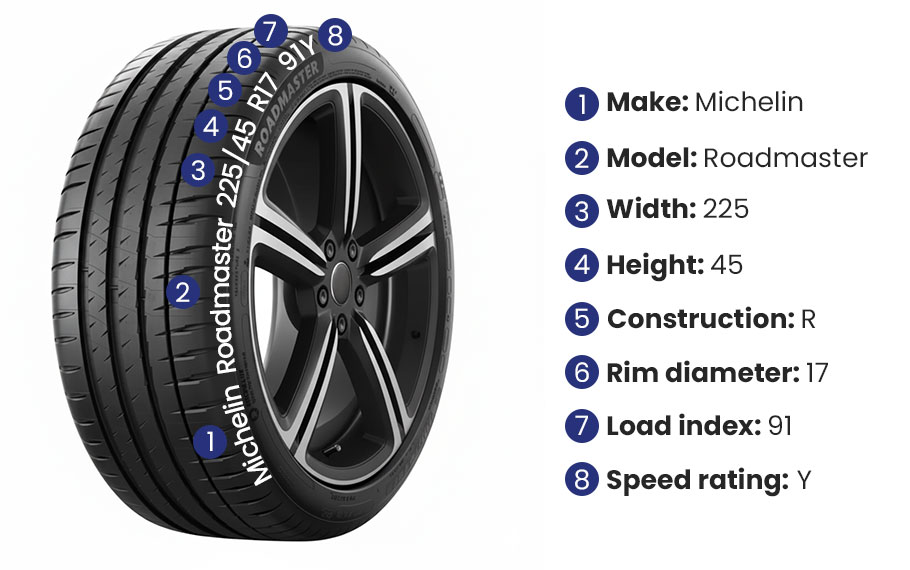
You may have noticed codes like “225/45 R17 91Y” on the sidewall of a tire. To many, these numbers sound like a secret language. Yet they contain vital information about your vehicle’s safety, comfort and performance.
At Alex Pneu et Mécanique, we always explain these details in simple terms, so that every motorist can choose his or her tires with complete confidence.
Make and model (1 and 2): the tire’s “personality
More than a logo
A tire’s brand name is never a coincidence. It reflects a technology, a way of conceiving the road, and above all a level of reliability.
As for the model, it has a direct influence on the vehicle’s behavior: stability, comfort, grip in the rain, lifespan… Each model has its strengths, and our team takes the time to explain them according to your real needs.
Understanding dimensions: width, height (3, 4) and diameter 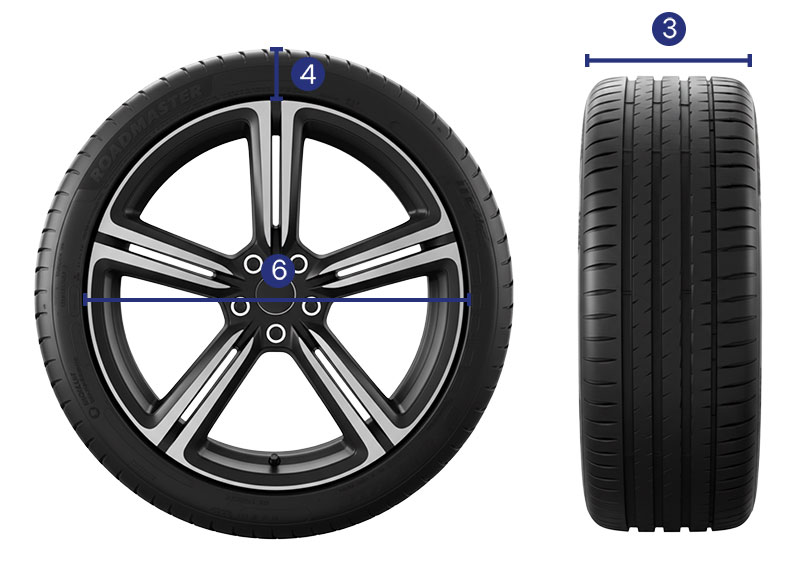
Why these numbers are important
The type designation 225/45 R17 provides essential information on tire width, sidewall height and rim diameter.
These values influence..:
- handling
- comfort on potholes
- fuel consumption
- steering precision
For example, a wide tire offers better grip, but consumes slightly more fuel. A higher sidewall absorbs shocks better, which is appreciated on our Montreal roads.
The frame (5): R, B or D – what do these letters stand for?
The tire’s “skeleton”
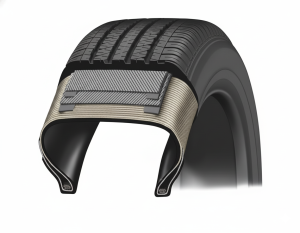
The next letter in the code describes the tire’s internal structure:
- R for radial (the current standard for cars)
- B for belted
- D for diagonal
Structure influences tire flexibility, cornering behavior and impact absorption. Radial tires dominate today, as they offer a good balance between performance, durability and comfort.
Rim diameter (6): a key element of compatibility
The right diameter for safety
The number below indicates the rim diameter, in inches. It’s not just an aesthetic detail: an incompatible diameter can compromise driving precision and the strength of the assembly.
When we provide a tire-changing service, we always check these correspondences to ensure a safe and durable installation.
Load index (7): how much can your tire bear?
Essential safety data
The load index indicates the maximum weight each tire can carry. The higher the index, the greater the load capacity.
This is crucial for SUVs, vans and vehicles that regularly transport equipment, as well as for trailers.
For drivers of minivans or light trucks, this index is just as important as the suspension & steering model fitted to your vehicle.
| Index | lbs | kg | Index | lbs | kg | |
|---|---|---|---|---|---|---|
| 71 | 761 | 345 | 91 | 1356 | 615 | |
| 72 | 783 | 355 | 92 | 1389 | 630 | |
| 73 | 805 | 365 | 93 | 1433 | 650 | |
| 74 | 827 | 375 | 94 | 1477 | 670 | |
| 75 | 853 | 387 | 95 | 1521 | 690 | |
| 76 | 882 | 400 | 96 | 1565 | 710 | |
| 77 | 908 | 412 | 97 | 1609 | 730 | |
| 78 | 937 | 425 | 98 | 1653 | 750 | |
| 79 | 963 | 437 | 99 | 1709 | 775 | |
| 80 | 992 | 450 | 100 | 1764 | 800 | |
| 81 | 1019 | 462 | 101 | 1819 | 825 | |
| 82 | 1047 | 475 | 102 | 1874 | 850 | |
| 83 | 1074 | 487 | 103 | 1929 | 875 | |
| 84 | 1102 | 500 | 104 | 1984 | 900 | |
| 85 | 1135 | 515 | 105 | 2039 | 925 | |
| 86 | 1168 | 530 | 106 | 2094 | 950 | |
| 87 | 1201 | 545 | 107 | 2149 | 975 | |
| 88 | 1235 | 560 | 108 | 2205 | 1000 | |
| 89 | 1279 | 580 | 109 | 2271 | 1030 | |
| 90 | 1323 | 600 | 110 | 2337 | 1060 |
Speed index (8): more than maximum speed
A question of road behaviour
The speed rating not only defines the maximum speed at which the tire can be driven. It also influences..:
- grip
- braking distance
- driving precision
- heat resistance
Going up a gear can improve vehicle handling, while going down can be dangerous, especially when braking hard or on freeways.
| Index | MAXIMUM SPEED | TYPE / VEHICLE TYPE |
|---|---|---|
| L | 75 mph 120 km/h | Off-road and van tires  |
| M | 81 mph 130 km/h | Temporary use spare tires  |
| N | 87 mph 140 km/h | Temporary-use spare tires |
| Q | 99 mph 160 km/h | Winter tires for 4×4 |
| R | 106 mph 170 km/h | Heavy-duty van  |
| S | 112 mph 180 km/h | Family sedans and vans  |
| T | 118 mph 190 km/h | Family sedans and vans |
| U | 124 mph 200 km/h | Sedans and coupes  |
| H | 130 mph 210 km/h | Sport sedans and coupes |
| V | 149 mph 240 km/h | Sports cars  |
| Z | 149+ mph 240+ km/h | Sports cars |
| W | 168 mph 270 km/h | Exotic sports cars  |
| Y | 186 mph 300 km/h | Exotic sports cars |
| (Y) | 186+ mph 300+ km/h | Exotic sports cars |
Reading a tire is taking care of your safety
Behind every number and letter is information that contributes to your safety and your car’s performance. Once you know how to interpret them, choosing the right tires becomes much simpler.
At Alex Pneu et Mécanique, we always take the time to guide you, whether it’s to understand these markings or to help you select the model best suited to your driving style.
Ride with confidence
Understanding your tires also means better protecting your vehicle and those who ride on it. If you have any questions, or would like help choosing the right tires, our family team is here to help.
Schedule your appointment here: https://alex.ca/appointment/
Or discover our complete tire sales service.